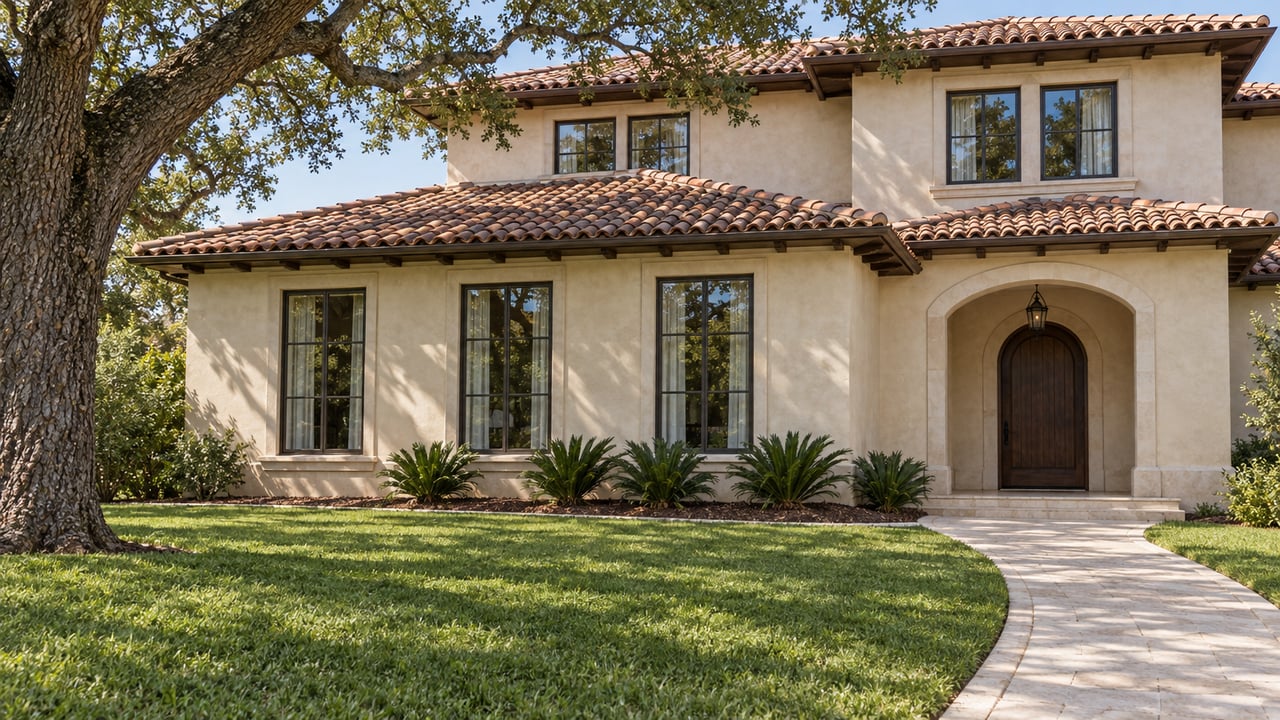
A buyer searching "Celebration FL homes for sale" this month sees a median number, mentally files it away, and starts touring. Two showings later, they're standing in a three-bedroom townhome-condo hybrid in Artisan Park listed under $500,000, then driving fifteen minutes to a five-bedroom estate tucked behind a forest preserve in Aquila Reserve listed north of $1.5 million. Both addresses say Celebration, FL 34747. Both come with the same resident ID card. Neither one looks anything like the number they started with.
That gap is not a fluke of timing or inventory. It is what happens when eight structurally different housing products get compressed into a single headline figure.
What the reported number is actually averaging
Depending on which site you check this month, Celebration's median sale price reads differently, and the differences are real enough to matter. Redfin puts the median sale price at $699,000 over the three months ending May 2026, up 3.9% from the same period a year earlier, with price per square foot at $330, up 13.4% year over year, and homes selling in an average of 34 days. Movoto's June 2026 snapshot shows a median list price of $679,990, with 179 homes sold that month, up from 154 a year prior, but an average of 155 days on market, a huge jump from 63 days the year before. Orchard's trailing 30-day window this summer shows a lower $600,000 median and $341 per square foot.
None of these sources are wrong. They are measuring different slices of the same market at different points in the pipeline, sold price versus list price, a three-month rolling window versus a 30-day snapshot, and days-on-market counted from different starting lines. If you're comparing Celebration to another Central Florida community using a single quoted median, ask which window and which stage of the transaction that number is capturing before you build a budget around it.
But the bigger distortion isn't between websites. It's inside the town itself.
Seven villages, one town, wildly different math
Celebration was built in phases starting in 1996, and each phase carries its own product mix, builder, and price ceiling. Current active listings make the spread visible in a way a citywide median never will:
| Village | Active listings | Average listing price | What's driving the number |
|---|---|---|---|
| Artisan Park | 17 | $468,104 | Mixed density (roughly 300 single-family homes, 50 townhomes, 300 condos) pulls the average down |
| South Village | 34 | $825,341 | Largest inventory pool, wide range of home ages |
| West Village | 7 | $827,316 | Borders the golf course and elementary school |
| North Village | 18 | $843,082 | Widest individual range, listings run from roughly $200,000 to $5,000,000 |
| Island Village | 7 | $855,967 | Newest construction, built entirely by Mattamy Homes starting in the late 2010s |
| Lake Evalyn | 2 | $919,000 | Thin inventory means one listing can swing the average significantly |
| East Village / Aquila Reserve | 9 | $1,532,890 | Aquila Reserve is single-family only, just 78 homes, set behind a forest preserve |
The spread between the cheapest village average and the most expensive is over $1 million, inside the same zip code, the same school zone, and the same master association.
Some of that gap is straightforward: Aquila Reserve was the last village built by the original Celebration Company, and it only ever contained 78 single-family homes tucked behind a conservation area, no condos, no townhomes, nothing to pull the average down. Artisan Park sits at the opposite end for the opposite reason. It's the one village Disney's Celebration Company didn't build. Arvida, a St. Joe Company subsidiary, developed it with Issa Homes as a principal builder, and it deliberately mixed roughly 300 single-family homes with 50 townhomes and 300 condos across 150 acres, so its average reflects three very different price points blended together.
Lake Evalyn is a caution of its own kind. With only two active listings, its $919,000 average isn't really a market signal yet. It's two data points. A buyer using that number to anchor expectations is trusting a sample size that would make any statistician wince.
The bridge that changes what "walkable" means
Island Village adds a wrinkle that price per square foot can't capture. It sits on the western edge of Celebration, separated from the original 1990s villages by I-4, and connected back to them only by the Celebration Avenue trellis bridge. Mattamy Homes has been delivering it in phases since the late 2010s, working toward roughly 1,000 homes ranging from 1,500 to 3,250 square feet, with a contemporary architectural style that reads differently from the postmodern, neotraditional look of the original Town Center and Main Village.
Island Village was built with its own resort-style pool, clubhouse, and pavilion specifically so residents wouldn't need to cross that bridge for daily amenities. That's a real design choice, not an afterthought, and it means a listing agent's claim that a home is "in Celebration, walk to Market Street" needs a follow-up question if the address is in Island Village. The walk exists. It crosses a highway bridge to get there.
The fee layer that doesn't travel with the listing price
Every residential owner in Celebration pays into CROA, the Celebration Residential Owners Association, and those dues run roughly $280 to $490 per month depending on the property type and village. That part is consistent town-wide. What isn't consistent is what sits on top of it.
Artisan Park and Aquila Reserve both carry an additional sub-association fee, typically $60 to $150 per month, on top of the CROA due. In Artisan Park's case, that money funds the Artisan Club, the village's private clubhouse with its pool, fitness center, and event space, plus the interior parks and trails that only Artisan Park residents maintain. The additional fee helps fund Artisan Park's private amenity center, and the dual-HOA structure is part of the price of having one.
A $650,000 listing in Artisan Park and a $650,000 listing in North Village are not the same monthly payment, even before a mortgage payment is calculated.
For the full breakdown of how CROA, sub-associations, and any applicable CDD assessments stack up by parcel, our complete Celebration HOA and fee guide walks through it property type by property type. The short version for this comparison: don't compare two Celebration listings on price alone. Compare the all-in monthly number.
What to actually do with this before you set a budget
If you're comparing Celebration's median to a number you saw for another Central Florida community, treat the citywide figure as a starting question, not an answer. Ask your agent for a village-level pull, not a townwide one. Ask whether the home you're touring carries a sub-association fee on top of CROA. And if the village has thin inventory, like Lake Evalyn's two active listings, ask how many homes have actually sold there in the past year, not just what's listed today.
The number that matters is the one that describes the house you're standing in, not the town it happens to sit in.
A couple of things buyers ask once they see the spread
Does the age of a village affect resale later, not just purchase price now? Construction era does show up in the numbers here. The original villages built 1996 to 2002 carry different maintenance profiles than Island Village's 2021-and-later inventory, and that's worth a conversation with an inspector as much as with an agent.
Why does Aquila Reserve command such a premium if it's the least central location? Seclusion is the product being sold there. It's the furthest village from downtown, bordered by forest preserve, and limited to just 78 single-family homes with no attached product to dilute the average. Scarcity and privacy, not proximity, are driving that number.
If you're trying to figure out which Celebration village actually fits your budget and the way you want to live day to day, reach out to Abe Mendez for a straight comparison across the villages that make sense for your number, not just the one the portals average together.
This article is general information, not legal, tax or financial advice. Consult a qualified professional about your situation.